Cloud Infrastructure Security Best Practices
Abstract
How to secure cloud infrastructure as a continuous assurance system across identity, network, workloads, data, applications, monitoring, and recovery.
Cloud infrastructure security best practices are not a checklist of isolated controls. In modern environments, securing the cloud means building evidence that your identity, network, workload, data, application, monitoring, and recovery controls work together under real operating conditions [1][2].
That distinction matters. Ardagna et al. separate cloud "security" from cloud "assurance": security is the set of controls you deploy, while assurance is the evidence that those controls hold in practice [1]. For infrastructure teams, that means cloud security best practices should be designed as a continuous verification system, not a one-time hardening exercise [1][6].
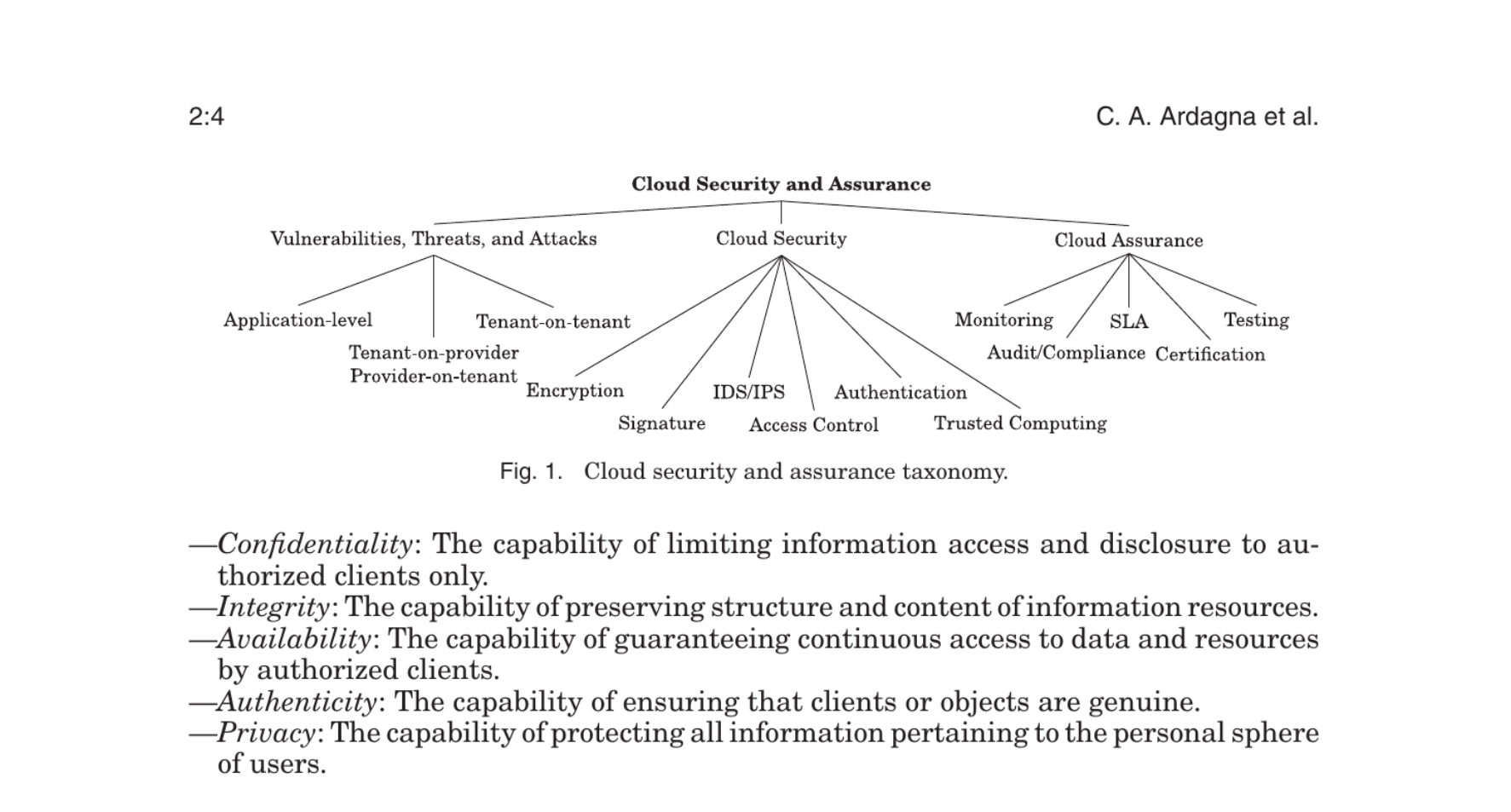 Cloud security and assurance taxonomy from a survey of cloud security research.Download
Research figure: Cloud security and assurance taxonomy from Ardagna et al. [1].
The practical goal is simple: protect cloud data, prevent unauthorized control-plane access, reduce blast radius, detect runtime abuse, and recover safely when something goes wrong [1][2][6]. The hard part is that cloud infrastructure spans many layers: IaaS, PaaS, SaaS, Kubernetes, container images, service meshes, CI/CD pipelines, cloud APIs, secrets, logs, and third-party cloud native security services [2][3][4][5].
Start With The Cloud Attack Surface
The best cloud security tips begin with attack-surface clarity. A 2022 Computers & Security survey organizes cloud computing security around service-based models: IaaS, PaaS, and SaaS [2]. That model remains useful because each layer creates different responsibilities [2].
In IaaS, teams usually own operating systems, network controls, storage configuration, identities, secrets, workload configuration, and monitoring [2]. In PaaS, the provider abstracts more of the platform, but teams still own identity, data access, application configuration, secrets, and deployment pipelines [2][5]. In SaaS, teams own tenant configuration, user access, data governance, audit logging, and integration risk [2].
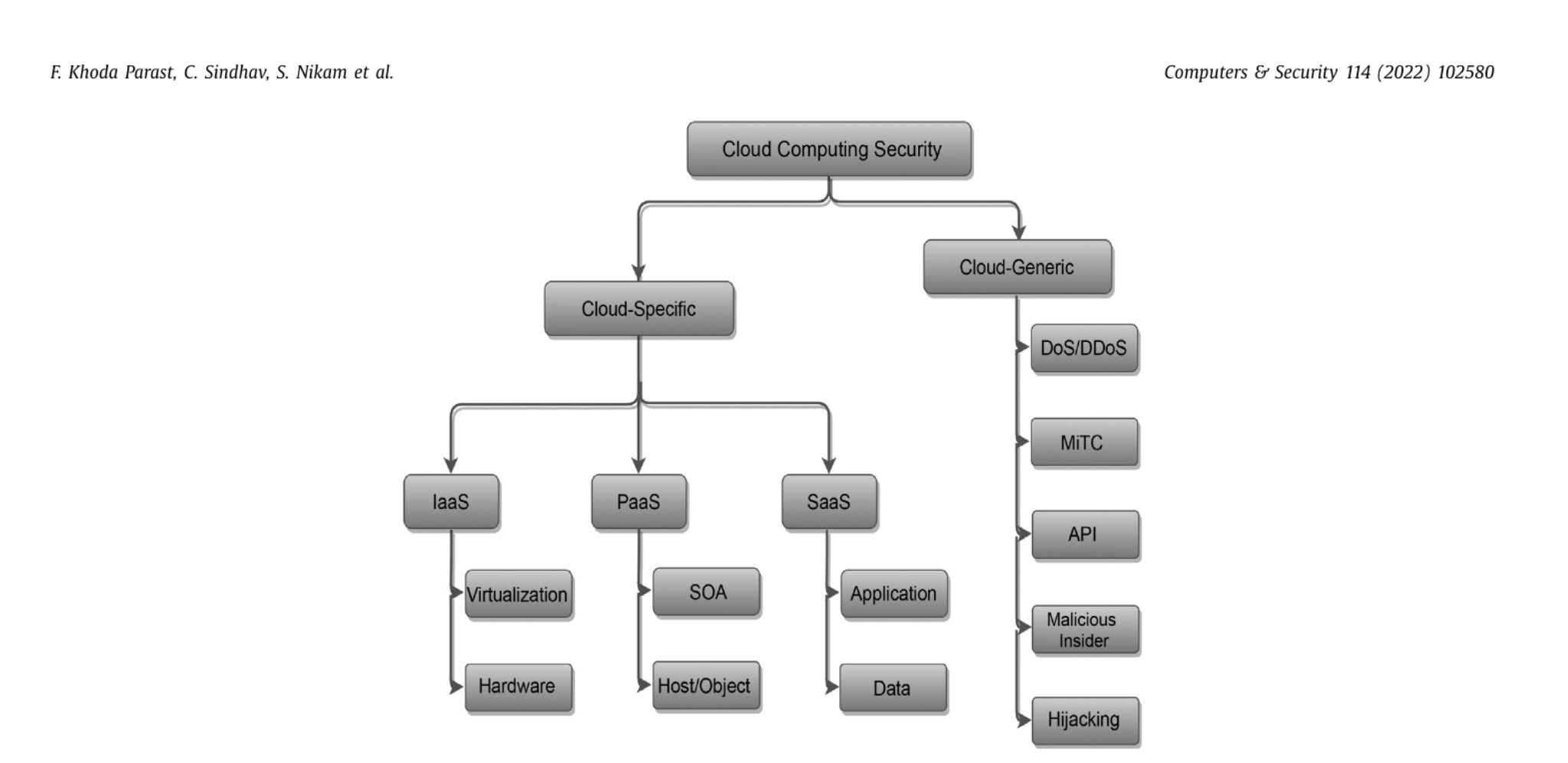 Cloud computing security taxonomy by service model.Download
Research figure: Cloud computing security taxonomy from "Cloud Computing Security: A Survey of Service-Based Models" [2].
This creates the first best practice: do not write one generic cloud security policy for every environment. Write cloud security policies by layer, service model, and ownership boundary [1][2]. A storage bucket, a Kubernetes API server, a GitHub Actions workflow, a database service, and a SaaS admin console need different controls and different evidence [1][2][3][4][5].
Use A Layered Cloud Security Architecture
Cloud infrastructure security standards best practices converge around defense in depth [1][2][4]. A single cloud computing security software category cannot cover the whole stack [1][4][7]. You need preventive controls, detective controls, runtime security, vulnerability management, and assurance mechanisms [1][3][4][7].
A practical layered model synthesizes the cloud assurance, service-model, container-security, cloud-native vulnerability, IaC, chaos-engineering, and SIEM research used in this article [1][2][3][4][5][6][7]:
| Layer | Primary risk | Best-practice controls | Evidence to collect |
|---|---|---|---|
| Identity | Stolen credentials, excessive permissions | SSO, MFA, least privilege IAM, short-lived credentials | Access reviews, policy diffs, privileged-session logs |
| Network | Public exposure, lateral movement | Private subnets, security groups, service mesh policy, egress control | Flow logs, firewall policy tests, external exposure scans |
| Workload | Vulnerable images, insecure pods, weak host isolation | Image scanning, admission control, seccomp, AppArmor/SELinux, runtime detection | SBOMs, scan results, admission logs, runtime alerts |
| Data | Leakage, data remanence, weak encryption | Encryption at rest and in transit, key rotation, object-level permissions | KMS logs, bucket policies, backup restore tests |
| Application | Broken auth, insecure APIs, supply chain flaws | SAST, DAST, dependency scanning, API testing, threat modeling | CI/CD results, vulnerability SLAs, test artifacts |
| Monitoring | Blind spots, delayed response | SIEM, cloud based security monitoring, endpoint telemetry, alert tuning | Alert coverage maps, incident timelines, rule tests |
| Recovery | Ransomware, destructive actions, failed rollback | Immutable backups, tested restores, infrastructure rebuild automation | Restore drills, recovery time metrics, runbook tests |
This is where cloud security solutions and cloud security services should be evaluated carefully. A cloud workload protection platform, CNAPP platform, SIEM, vulnerability scanner, CSPM, or application security solution is useful only if it covers a clearly defined layer and produces operational evidence [1][4][7].
Protect Identity First
Most cloud breaches do not require an exotic exploit. They often exploit weak identity, over-permissioned roles, leaked access keys, public admin interfaces, misconfiguration, or missing monitoring [1][2][6]. That is why identity and access management should be the first control plane to harden [1][2][6].
Use these baseline practices, which align with cloud assurance, service-layer security, and misconfiguration-validation research [1][2][6]:
- Require phishing-resistant MFA for privileged users.
- Disable long-lived access keys wherever short-lived workload identity can be used.
- Split human, workload, break-glass, and automation roles.
- Apply least privilege using task-specific policies instead of broad administrator roles.
- Review high-risk permissions such as
iam:*,sts:AssumeRole,kms:Decrypt, wildcard storage access, and Kubernetescluster-admin. - Alert on privilege escalation, policy attachment, access-key creation, unusual region usage, and anomalous console access.
Cloud information security work often fails when teams treat IAM as a setup task rather than an active attack surface [1][6]. IAM policies should be reviewed like code, tested in CI, and continuously monitored in production [5][6][7].
Protect Cloud Data With Encryption And Access Boundaries
Cloud data security best practices start with encryption, but they do not end there. Encryption protects confidentiality only if key management and access policy are also sound [1][2].
Use these controls for cloud data storage security, derived from the service-model security taxonomy, assurance framing, and security-chaos validation model [1][2][6]:
- Encrypt data at rest with managed keys or customer-managed keys depending on regulatory needs.
- Encrypt traffic between services, not just traffic from users to public endpoints.
- Rotate keys and remove unused keys.
- Use separate keys for separate blast-radius boundaries.
- Block public storage access by default.
- Log object reads, writes, deletes, policy changes, and key-use events.
- Test backup restoration, not just backup creation.
If the goal is how to protect your cloud data from hackers, the answer is layered: strong identity, tight object policies, encryption, monitoring, immutable backups, and validated recovery [1][2][6][7]. Effective strategies for protecting personal data in cloud environments also require data classification, retention rules, and region-aware governance [1][2].
Harden Containers And Cloud-Native Workloads
For cloud-native infrastructure, container security is part of infrastructure security. Sultan et al. frame container risk around four relationships: protecting a container from the application inside it, protecting containers from each other, protecting the host from containers, and protecting containers from a malicious or semi-honest host [3].
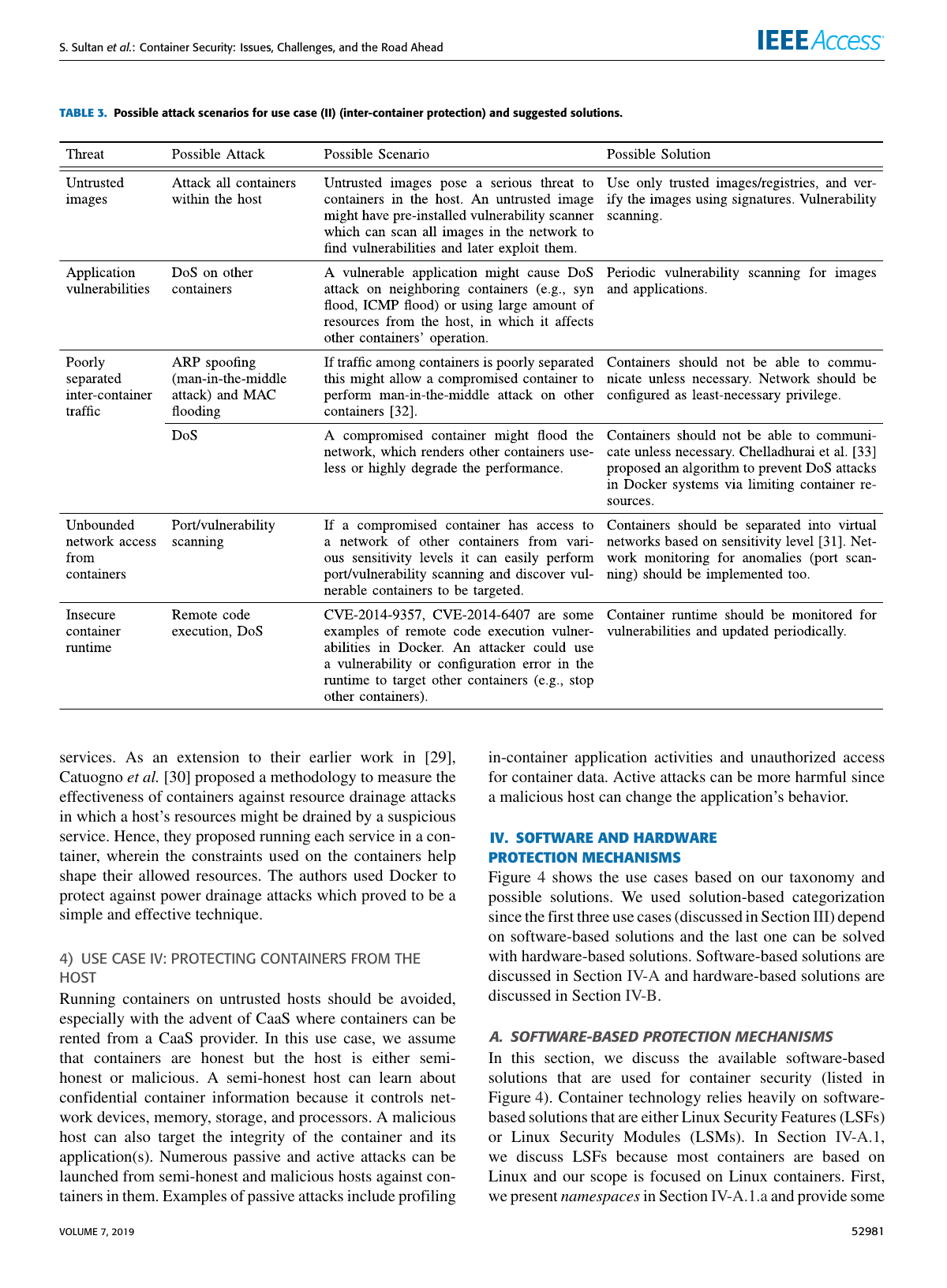 Container security threat model and use cases.Download
Research figure: Container threat model and use-case framing from Sultan et al. [3].
That framing translates into concrete cloud computing security best practices [3][4]:
- Scan base images and application images before deployment.
- Use minimal images and remove package managers from production images where possible.
- Pin image digests rather than mutable tags.
- Enforce non-root containers.
- Drop Linux capabilities by default.
- Use
seccomp, AppArmor, SELinux, or another Linux Security Module profile. - Separate build, registry, staging, and production trust boundaries.
- Use admission control to reject risky workloads before they reach the cluster.
- Add container runtime protection for behavior that cannot be detected statically.
Runtime security tools matter because static checks cannot see what a workload actually does after deployment [3][4]. Container runtime scanning, syscall monitoring, eBPF-based telemetry, and policy enforcement can detect behaviors such as unexpected shell execution, privilege escalation, crypto-mining, suspicious file writes, and network beacons [3][4].
Secure Kubernetes By Layer, Not By Slogan
The Full-Stack Vulnerability Analysis of the Cloud-Native Platform paper is especially useful because it maps vulnerabilities across Docker, Kubernetes, CNI, and Istio rather than treating "Kubernetes security" as one category [4]. It reports, for example, that in the Kubernetes layer the API Server contributes over 30% of the analyzed vulnerabilities, and privilege-escalation issues account for 80% of attacks in that section [4]. For CNI, the paper reports that 90% of vulnerabilities are in layer 3 and 90% enable privilege escalation [4].
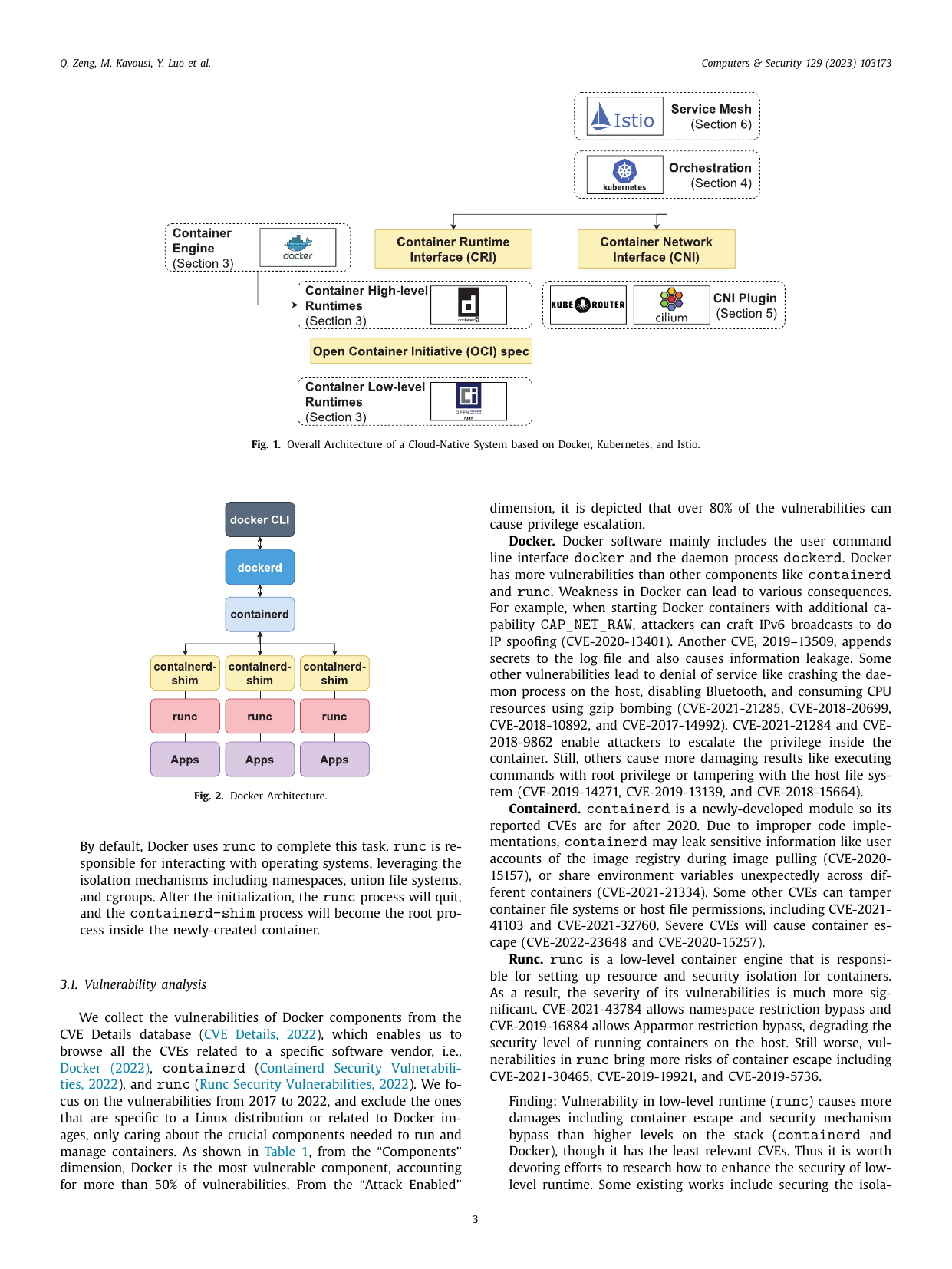 Cloud-native system architecture and Docker architecture used for stack-level vulnerability analysis.Download
Research figure: Cloud-native platform architecture from "Full-Stack Vulnerability Analysis of the Cloud-Native Platform" [4].
The takeaway is direct: Kubernetes security testing should cover the control plane, worker nodes, container runtime, CNI, ingress, service mesh, secrets, CI/CD path, and application workloads [4][5].
Prioritize these controls based on the Kubernetes and container attack surfaces identified in the literature [3][4]:
- Restrict Kubernetes API access to trusted networks and identities.
- Use RBAC least privilege and avoid broad
cluster-admingrants. - Enable audit logging and retain logs centrally.
- Enforce Pod Security Standards or equivalent admission policies.
- Use network policies to limit pod-to-pod communication.
- Protect etcd with encryption, access control, and backup testing.
- Patch managed and self-managed cluster components promptly.
- Monitor high-risk runtime events with Falco, Tetragon, KubeArmor, Tracee, or similar runtime security tools.
This is also where CNAPP platforms and cloud native application protection platform tooling can help. A CNAPP security program should connect CSPM, CIEM, CWPP, Kubernetes posture management, IaC scanning, image vulnerability scanning, and runtime detection [1][4][5][7]. But tool consolidation should not replace engineering judgment: top CNAPP tools for cloud security management still need policy ownership, alert tuning, and incident response integration [1][7].
Shift Security Into Infrastructure As Code
Cloud security implementation is easier to sustain when infrastructure is declared, reviewed, tested, and versioned [5]. Ibrahim et al. propose a workflow using Terraform, Ansible, AWS, and tfsec to scan IaC before cloud resources are provisioned [5]. Its main practical lesson is that automated provisioning is not the same as secured automated provisioning [5].
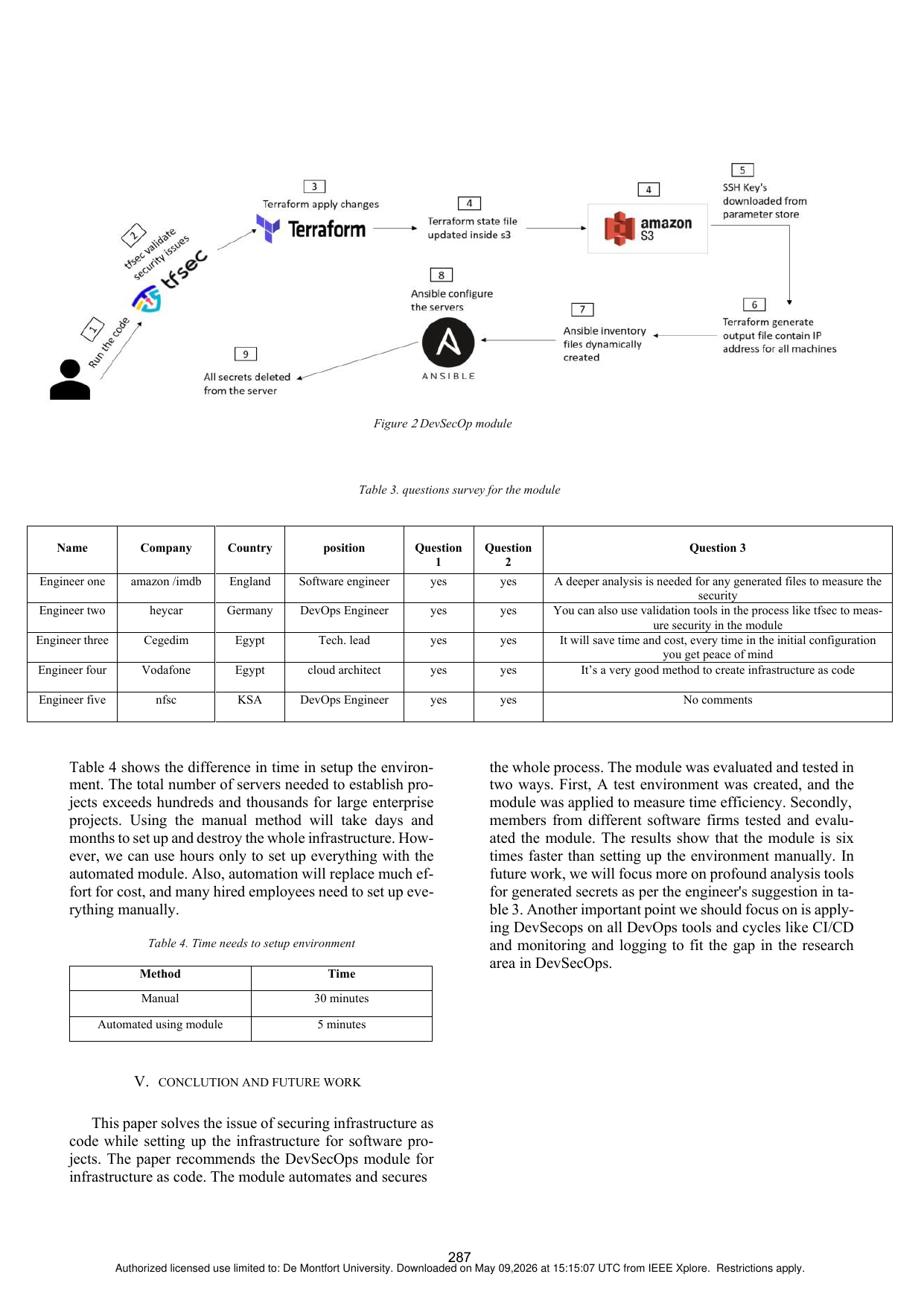 Infrastructure as Code DevSecOps module diagram and evaluation context.Download
Research figure: DevSecOps module for IaC workflows from Ibrahim et al. [5].
IaC security should check for infrastructure risks commonly associated with misconfiguration, weak identity, weak logging, and insufficient policy validation [5][6]:
- Public storage buckets and public databases.
- Overly permissive security groups.
- Missing encryption.
- Weak logging or retention settings.
- Long-lived secrets in code or state files.
- Missing backup policies.
- Excessive IAM permissions.
- Missing Kubernetes admission or network policies.
Open source vulnerability scanner coverage should also sit inside CI/CD [5]. Use scanning tools for dependencies, CVEs, container images, Terraform, Kubernetes manifests, secrets, and licenses [3][4][5]. No single CVE scanner or vulnerability checker is enough; pipeline security requires multiple checks mapped to different artifact types [3][4][5].
Add Application Security Testing Tools
Cloud infrastructure and applications are now tightly coupled. A public API behind a managed load balancer, a vulnerable container image, a permissive IAM role, and a weak CI/CD workflow can become one exploit path [3][4][5][6].
That is why the best application security testing solution is usually not one product. Mature programs combine application, dependency, container, IaC, and runtime controls [3][4][5]:
- SAST for source-code weaknesses.
- SCA for dependency risk.
- DAST for running web applications.
- API security testing for authentication, authorization, and schema issues.
- Container image scanning tools for image vulnerability coverage.
- IaC scanning for cloud misconfiguration.
- Runtime detection for behaviors missed before deployment.
Application security tools should feed the same risk workflow as cloud posture findings [1][4][5]. If application security software identifies a vulnerable dependency in a workload that also has internet exposure and broad cloud permissions, that issue should be prioritized above an isolated low-impact finding [4][6].
Monitor Continuously With SIEM And Runtime Telemetry
Cloud based security monitoring should collect signals from cloud control planes, workloads, networks, identity systems, CI/CD, Kubernetes, and endpoints [1][4][7]. Amami et al. compare Wazuh, ELK, and OSSIM and rate Wazuh strongly for reliability, cost-effectiveness, endpoint availability, file integrity monitoring, intrusion detection, and scalability [7]. While that paper is more traditional SIEM than Kubernetes-native runtime security, its deployment pattern is still useful: collect endpoint logs, centralize events, customize rules, and validate against simulated attacks [7].
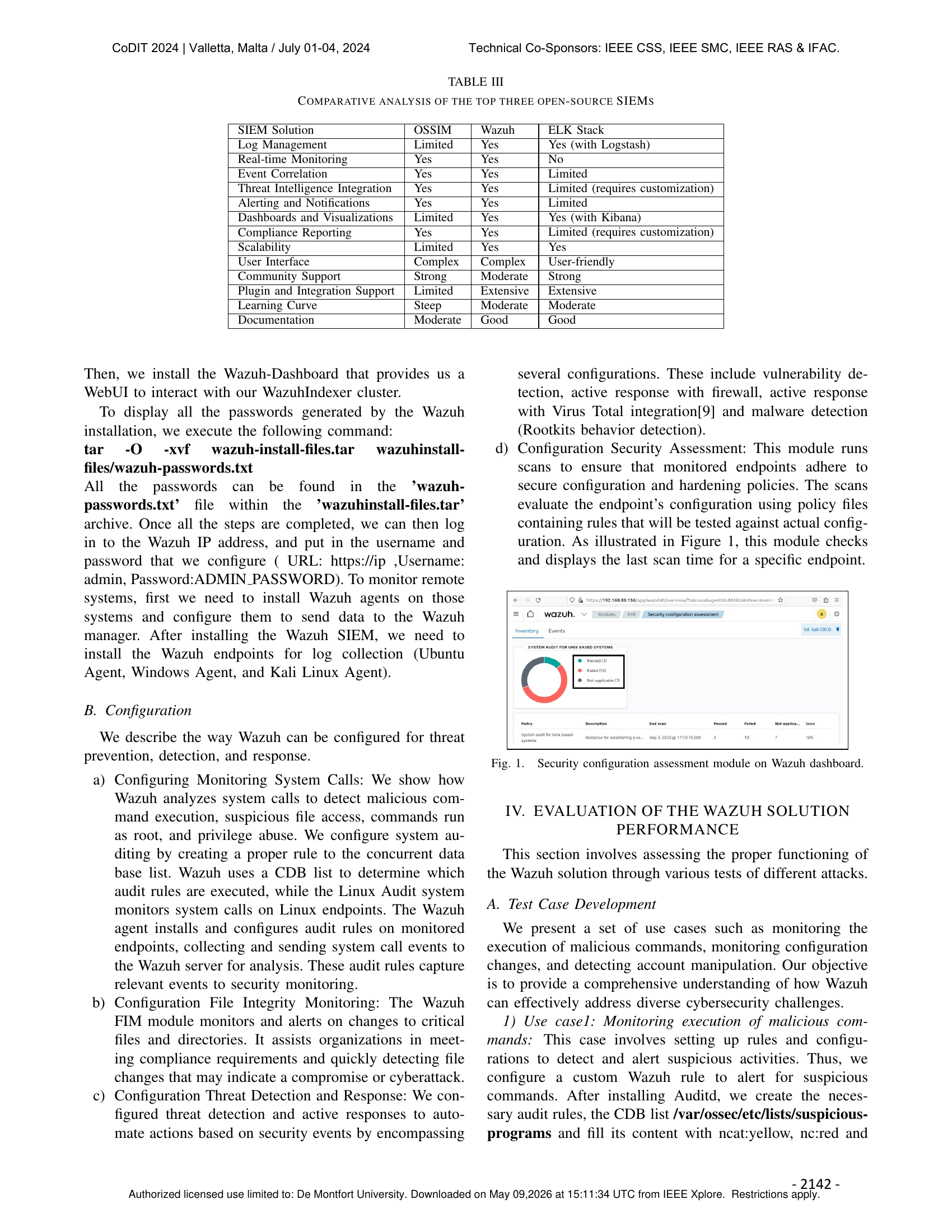 Open-source SIEM comparison and deployment material from Wazuh research.Download
Research figure/table page from Amami et al. [7].
Security monitoring in cloud computing should include control-plane, workload, network, endpoint, CI/CD, and object-storage signals [1][4][7]:
- IAM changes and suspicious login behavior.
- Cloud API calls for high-risk services.
- Network flow logs and DNS activity.
- Kubernetes audit logs.
- Container runtime events.
- File integrity monitoring for critical hosts.
- Vulnerability and patch status.
- CI/CD pipeline changes and secret exposure.
- Object storage access and policy changes.
Cloud security monitoring solutions need tuning [7]. A noisy SIEM or runtime detector becomes shelfware. Define critical detections, test them, measure false positives, and connect alerts to incident response playbooks [1][6][7].
Validate Controls With Security Chaos Engineering
Cloud security best practices should be tested [1][6]. Torkura et al. argue for risk-driven fault injection: deliberately injecting security faults to expose misconfigurations, test detection, and validate recovery [6]. In its evaluation, CloudStrike covered more than 20 fault-injection rules, compared with 3 in the ChaoSlingr comparison described by the authors [6].
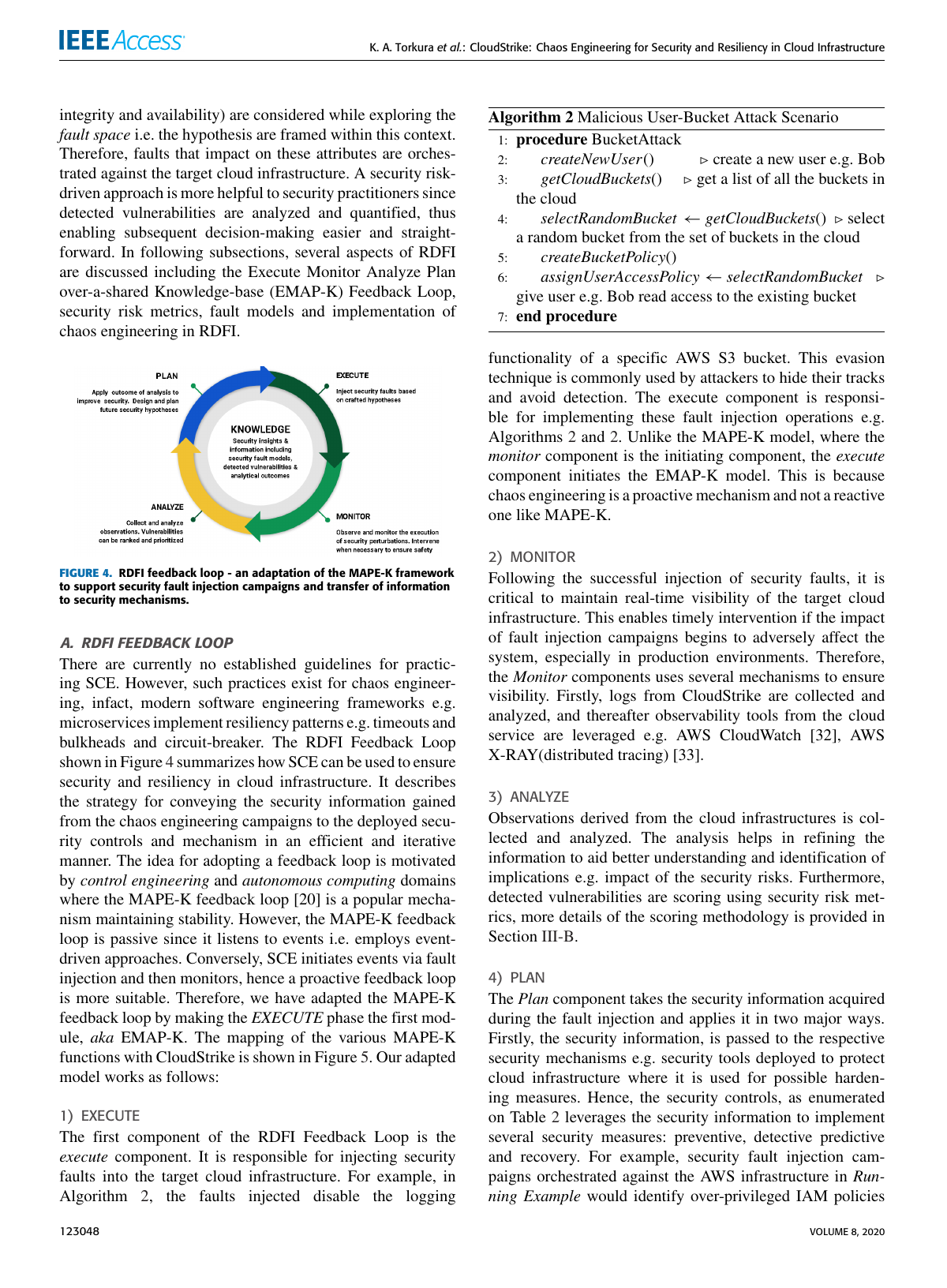 CloudStrike risk-driven fault-injection feedback loop.Download
Research figure: RDFI feedback loop from Torkura et al. [6].
Use this idea carefully in production. Start in staging or controlled accounts, then test narrow scenarios that validate misconfiguration detection, alerting, rollback, and recovery [6]:
- A storage bucket becomes public.
- A privileged IAM policy is attached.
- A security group exposes SSH or a database port.
- Logging is disabled.
- A Kubernetes workload requests privileged mode.
- A suspicious shell appears in a container.
- A secret appears in a CI/CD log.
The point is not to break things for spectacle. The point is to prove that cloud security policies, cloud security monitoring, alert routing, rollback, and recovery controls work together [1][6][7].
Choosing Cloud Security Tools
Cloud computing security software should be selected against your architecture and evidence needs [1][2][4][7]. Use this selection model:
| Tool category | Use when | Watch out for |
|---|---|---|
| CSPM | You need posture management across cloud accounts | Findings can be noisy without ownership and suppression rules |
| CIEM | You need identity entitlement analysis | Needs deep IAM context and regular review workflows |
| CWPP | You need cloud workload protection across hosts, containers, and VMs | Agent coverage and runtime overhead matter |
| CNAPP | You want posture, workload, identity, and pipeline signals in one platform | Breadth can hide shallow coverage in specific layers |
| SIEM | You need centralized detection and investigation | Requires rule engineering and data pipeline maintenance |
| Runtime security tools | You need behavior detection inside containers and Kubernetes | Needs tuning against normal workload behavior |
| Application security platform | You need code, dependency, API, and DAST coverage | Must integrate with developer workflows |
| Cloud scanner | You need quick discovery of misconfiguration or exposure | Point-in-time scans do not replace continuous monitoring |
For smaller teams, open source tools can be effective if scope is clear: Wazuh for SIEM-style monitoring, Falco or Tetragon for Kubernetes runtime security, Trivy or Grype for image vulnerability scanning, Checkov or tfsec for IaC scanning, and OPA Gatekeeper or Kyverno for policy enforcement [3][4][5][7]. For larger teams, commercial cloud native security software may reduce integration burden, but only if it supports your actual cloud providers, Kubernetes distributions, CI/CD systems, and reporting obligations [1][2][4].
A Practical Implementation Roadmap
Use this phased roadmap for effective cloud security, synthesizing the assurance, service-model, container, cloud-native vulnerability, IaC, fault-injection, and SIEM research cited above [1][2][3][4][5][6][7]:
- Inventory cloud accounts, subscriptions, clusters, workloads, SaaS tenants, identities, and data stores.
- Define ownership boundaries using the shared responsibility model for each service.
- Enforce MFA, SSO, least privilege, and break-glass access controls.
- Remove public exposure from storage, databases, control planes, and management ports.
- Encrypt data at rest and in transit, then validate key-use logging.
- Add IaC, container image, dependency, and secret scanning to CI/CD.
- Enforce Kubernetes admission controls, network policies, RBAC, and audit logging.
- Deploy cloud based security monitoring across identity, network, workload, and data events.
- Connect SIEM, runtime security, and cloud posture findings to incident workflows.
- Test detections, backup restores, and rollback paths with controlled security exercises.
References
[1] C. Ardagna, R. Asal, E. Damiani, and Q. Vu, "From security to assurance in the cloud," ACM Computing Surveys, 2015, doi: 10.1145/2767005.
[2] F. Khoda Parast, C. Sindhav, S. Nikam, H. Izadi Yekta, K. B. Kent, and S. Hakak, "Cloud computing security: A survey of service-based models," Computers & Security, vol. 114, p. 102580, 2022, doi: 10.1016/j.cose.2021.102580.
[3] S. Sultan, I. Ahmad, and T. Dimitriou, "Container security: Issues, challenges, and the road ahead," IEEE Access, 2019, doi: 10.1109/ACCESS.2019.2911732.
[4] Q. Zeng, M. Kavousi, Y. Luo, L. Jin, and Y. Chen, "Full-stack vulnerability analysis of the cloud-native platform," Computers & Security, vol. 129, p. 103173, 2023, doi: 10.1016/j.cose.2023.103173.
[5] A. Ibrahim, A. Yousef, and W. Medhat, "DevSecOps: A security model for infrastructure as code over the cloud," in Proc. 2022 2nd International Mobile, Intelligent, and Ubiquitous Computing Conference (MIUCC), 2022, doi: 10.1109/MIUCC55081.2022.9781709.
[6] K. Torkura, M. Sukmana, F. Cheng, and C. Meinel, "CloudStrike: Chaos engineering for security and resiliency in cloud infrastructure," IEEE Access, 2020, doi: 10.1109/ACCESS.2020.3007338.
[7] R. Amami, M. Charfeddine, and M. Salma, "Exploration of open source SIEM tools and deployment of an appropriate Wazuh-based solution for strengthening cyberdefense," in Proc. 2024 10th International Conference on Control, Decision and Information Technologies (CoDIT), 2024, doi: 10.1109/CoDIT62066.2024.10708476.