The 21 Times Fallacy
Abstract
A detailed break down of the epidemiology behind the twenty-one-times-a-month prostate-cancer claim, demonstrating how an arbitrary survey bracket, weak observational associations, and media simplification, and perhaps negligence, were turned into a false medical rule.
The internet has managed to turn one of the weakest forms of medical evidence into one of the most confident sexual commandments in use. You have probably heard the line already: ejaculate twenty-one times per month and a reduction in risk of prostate cancer happens. It gets delivered as if it were settled biology.
Clean. Numerical. Responsible. A recommendation disguised as a health advice. The implication is obvious. Masturbation is not merely tolerated. It is now considered by masses to do good for your body. It is no longer just harmless. It is protective. If you resist it, perhaps you are resisting selfcare itself.
In all honesty, this is nonsense.
The claim is not pure fabrication. It came from real observational studies. But by the time it reached headlines, influencers, and public campaigns, it had been stripped of every caveat that gave it meaning. The core evidence base is observational, self-reported, and inconsistent across studies, with the strongest signals clustering in lower-risk or localized disease rather than clearly lethal outcomes [1][2][3][4][7].
Observational means the researchers watched what people already did and looked for patterns; they did not assign anyone to ejaculate on a schedule.
What survived was the part that could go viral:
- a specific number
- a pleasurable behavior
- a cancer fear hook
- a built-in moral permission structure
- selfcare
That is why it spread. Not because it is a strong conclusion. Because it is a convenient and useful one. It provides a moral permission structure.
Which part of that structure are you still trying to protect?
The Number Means Nothing
The most important thing to understand is that 21 is not a biological threshold. It is not a magical cutoff discovered in the prostate. It is not a dosage point where tissue suddenly becomes protected. It is not a cellular switch.
It is a survey bucket.
The famous number comes out of the Health Professionals Follow-Up Study, a long-running Harvard cohort of health professionals, where men were asked to place themselves into pre-set ejaculation-frequency categories. One of the top categories was simply "21 or more times per month" [2][3].
That means the public took the upper edge of a questionnaire and hallucinated a law of nature. This is the equivalent of a food survey finding that people who eat "5 or more apples per week" seem healthier, and then turning that into a medical campaign claiming that exactly five apples unlock a protective mechanism. Twenty-one was just the top-label on a researcher's spreasheet. We were the ones who then turned it into a medical commandment.
It Does Not Protect Against the Cancer That Actually Kills
This is the part most people never hear. The widely cited Harvard analyses did not show a meaningful protective effect against lethal prostate cancer [2][3][4][7]. The better readings of the literature keep landing on a narrower claim: at most, a possible association with lower-risk or organ-confined disease, not a proven shield against aggressive cancer [2][3][4][7].
Organ-confined means the cancer is still limited to the prostate and has not clearly spread outside it. The Kaplan-Meier figure in the Rider paper [2] simply shows that the groups separated somewhat over time. It does not show that twenty-one times per month is a real biological threshold or a proven preventive dose.
Kaplan-Meier is just a survival curve, meaning a line showing how many people remain free of an event over time.
EPM in the legend means ejaculations per month.
Incidence is just the rate of new cases appearing over time.
The apparent inverse association was driven mainly by low-risk, localized, often indolent disease.
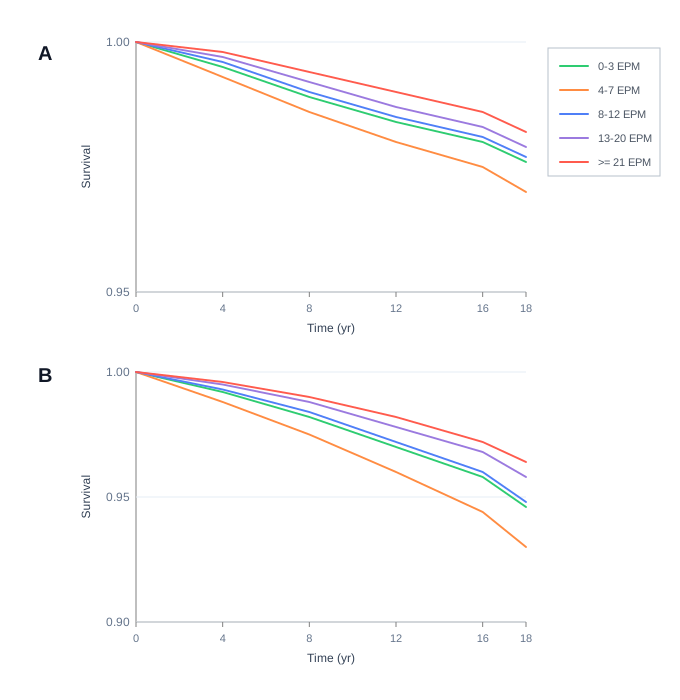 Reconstructed Kaplan-Meier figure with two panels comparing prostate-cancer-free survival across ejaculation-frequency groups. A is the full view. B zooms in on the same curves so the small differences are easier to see. In both views, the highest-frequency group separates only modestly from the lower-frequency groups over follow-up rather than revealing any sharp threshold at twenty-one times per month.Download
This is a schematic reconstruction of Fig. 1 from the 2016 Rider et al. update. A is the full view and B zooms in on the same curves so the small differences are easier to see. It keeps the two-panel survival structure and the risk table, but it is still a reconstruction from the paper’s reported ordering, not the original image extract.
In plain language: the signal showed up around the kinds of tumors that are often slow, limited, and sometimes so clinically unimportant that modern medicine frequently watches them instead of treating them aggressively. That is not the same thing as preventing the forms of prostate cancer that invade, spread, metastasize, and kill.
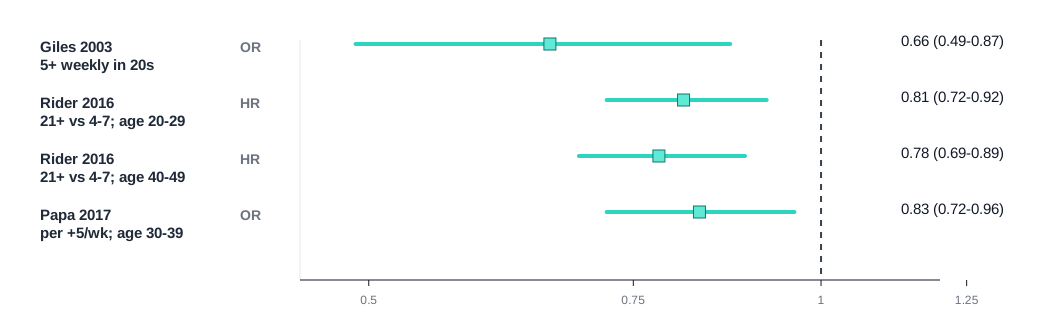 Forest plot comparing reported effect sizes across major ejaculation-frequency studies, with estimates mostly below 1.0 but clustered near the null and far from proving a protective threshold.Download
Each row is one study comparison. The square marks the study's main estimate, the horizontal bar shows the uncertainty around it, and the vertical line at 1.0 marks "no difference." These comparisons are about ejaculation frequency overall, not masturbation alone, so the category can include intercourse and other routes as well as masturbation. Estimates to the left of 1.0 lean toward fewer diagnosed cases in the higher-frequency groups.
So 0.66 means about a 34% lower relative incidence in that comparison, 0.81 means about 19% lower, 0.78 means about 22% lower, and 0.83 means about 17% lower. Those are not meaningless, but they are still modest effects, especially in observational studies.
More importantly, this kind of signal mostly tracks lower-risk or localized diagnoses. It does not meaningfully show up in lethal or metastatic cancer.
A genuinely strong effect would usually sit much farther from 1.0, with tighter uncertainty and more consistent replication across studies. So even in the lower-risk category, the apparent effect here is still modest rather than decisive. This chart therefore shows a study-dependent pattern in lower-risk disease, not a proven preventive threshold or mechanism against the cancers that matter most.
That distinction is everything. If a behavior does not materially reduce high-risk, advanced, or metastatic disease, then calling it "cancer prevention" is already a distortion. You are not allowed to blur together:
- a small association with low-grade diagnoses
- and protection from lethal malignancy
Those are not the same achievement.
If anything, the popular slogan works by exploiting the fact that most people do not know prostate cancer is a broad category containing radically different biological realities. Once you collapse that distinction, almost any weak signal can be turned into a triumph. People hear "19% to 22% lower risk" and imagine a dramatic real-world protection.
But that phrase is describing a relative comparison between groups, not the raw number of cases prevented. In the updated Harvard analysis, the celebrated difference translated into only a small absolute spread in annual incidence, meaning the groups were not actually very far apart in real terms.
For example, a result can sound large in relative terms if one group has about 9 cases per 1,000 men per year and the other has about 7; that looks impressive as a percentage drop, but it is still a small absolute gap in practice.
The headline made it sound like a shield. The underlying gap was much narrower than the slogan implies. That matters because a weak observational association already becomes less impressive once converted out of marketing language and back into absolute terms.
The Studies Cannot Carry What People Put on Them
The deeper problem is methodological. These studies were observational. They were not randomized trials. They did not assign men to sexual quotas. They did not isolate ejaculation as a clean causal intervention. They mostly relied on men reporting their own sexual histories, sometimes across decades. That is the same kind of setup where recall error, social desirability, selection effects, and confounding can easily overwhelm any weak signal [1][3][7].
The journal correspondence around the 2016 Harvard update makes the same basic point from the outside: critics raised p-hacking, recall bias, and selection bias, while the authors replied that their pre-specified analysis was meant to avoid fishing and that excluding T1a cases was intended to remove incidental, indolent tumors [9][10].
P-hacking means trying many analyses until one looks statistically significant.
T1a usually means a tiny, incidentally found tumor that shows up during surgery for something else, not because the cancer was already causing symptoms.
That is fragile evidence.
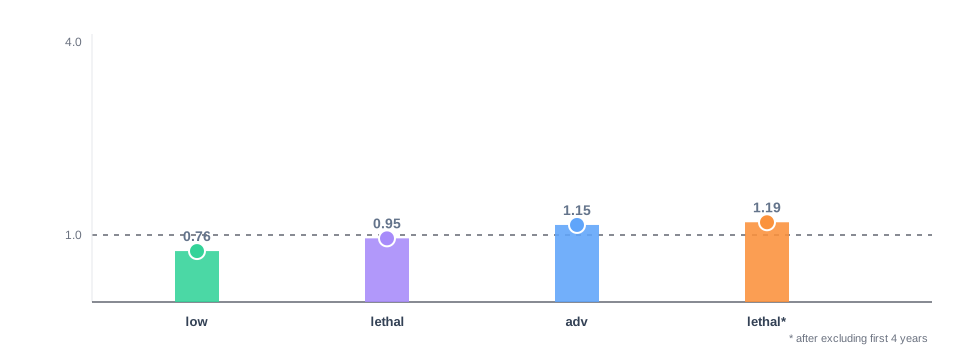 Comparison chart contrasting lower-risk prostate-cancer findings with lethal or advanced outcomes, where lower values would support the claim and the stronger downward signal appears mainly in low-risk disease.Download
This chart separates the apparent protective signal by outcome type. Lower values mean fewer cases in the higher-frequency group, so lower is the direction that would support the claim. The low-risk category sits lower, while the lethal and advanced categories stay much closer to no meaningful benefit. Once the analysis is pushed harder with later sensitivity checks, the case for a real protective effect weakens further.
In the figure, low means low-risk prostate cancer, adv means advanced disease, lethal means cases linked to prostate-cancer death or metastatic spread, and lethal* is the lethal estimate after excluding the first four years of follow-up as a stricter sensitivity check.
Men in middle and old age were being asked to recall their average monthly ejaculation frequency in their twenties and forties. That alone should sober anyone up. You are dealing with:
- memory distortion
- social desirability bias
- retrospective self-reporting
- selection effects
- confounding variables
Confounding means another factor is quietly driving the result, so the association looks stronger or cleaner than it really is. That is before you even get to the largest problem: healthier men generally have healthier sexual function. Men ejaculating frequently later in life are often not a random sample. They are more likely to have:
- better vascular health
- better endocrine function
- lower disease burden
- lower body mass
- higher energy
- higher general physiological robustness
So what are you measuring? The protective force of ejaculation itself? Or the fact that healthier men tend to do more healthy-man things, including remaining sexually functional? A great deal of epidemiology dies right there. The behavior looks causative only because it is downstream from the real drivers.
Reverse Causation Is a Serious Problem Here
There is another possibility that ruins the neat story: low ejaculation frequency may not be causing risk. It may be reflecting disease that is already developing. That reverse-causation problem shows up repeatedly in the literature, including analyses that treat frequent ejaculation as a possible marker of vitality rather than a direct causal lever [1][3][4][7].
Prostate disease does not appear overnight. It has a long natural history. Subclinical inflammation, benign prostatic enlargement, urinary symptoms, pelvic discomfort, endocrine deterioration, erectile dysfunction, and early pathological changes can all suppress libido and sexual function before a formal diagnosis ever arrives.
That means low frequency can easily be an effect rather than a cause. And the most extreme risk spikes tend to show up precisely where you would expect this problem to be worst: the men at the absolute bottom of the frequency scale, especially when low ejaculation frequency appears alongside urinary dysfunction and other signs of a prostate already going wrong.
That should make you suspicious immediately. It is exactly the pattern you would expect if sickness were suppressing sexuality long before formal diagnosis. This matters because once you confuse those directions, you produce one of the dumbest public-health errors possible: you treat a symptom marker as if it were a therapeutic lever.
That is how people end up thinking: "If low ejaculation tracks with worse outcomes, then high ejaculation must be protective." No. If a sick prostate contributes to reduced sexual function, then pushing the behavior upward does not solve the underlying disease process. It only proves that you misunderstood the arrow of causality.
The 2016 competing-risks analysis makes the imbalance clearer. By age 80, the lowest-frequency group had about a 3.8% higher risk of dying from something other than prostate cancer, while the highest-frequency group showed only about a 2.2% lower prostate-cancer risk [2]. Competing risks just means the analysis is not looking at prostate cancer by itself; it is also asking what else people were dying from along the way.
The Global Literature Does Not Tell One Clean Story
Another major weakness of the myth is that it depends on cultural tunnel vision. The public presentation of the claim acts as if the matter were settled. It is not. Once you step outside the small set of famous Harvard-linked findings, the landscape gets messy very fast. Some studies showed inverse associations. Some found no meaningful association. Some suggested more complicated age-specific patterns.
And some analyses of younger men pointed in the opposite direction entirely: more frequent masturbation or sexual activity in youth looked less like protection and more like a marker of a stronger androgenic environment, one that in some studies was linked to higher odds of earlier-onset or more aggressive prostate-cancer presentations rather than lower odds of later low-risk disease [3][7].
The original 2004 Harvard cohort report, the 2003 Australian case-control study, the 2016 updated cohort analysis, the 2017 aggressive-cancer case-control study, and the 2024 narrative review all point in different directions once you stop flattening the evidence into a slogan [1][2][3][7][13].
The later CAPLIFE case-control study and the 2018 prostate-tissue expression paper add more data, but they do not turn the association into proof of prevention [11][12]. That last point is especially destructive to the myth. If the same behavior can be sold as protective in older men with low-risk diagnoses, yet in some younger-age analyses looks more like a marker for earlier or more aggressive disease, then the public slogan has already lost its claim to being a universal biological law.
That should immediately put rest to the slogan.
When global evidence gives you contradiction instead of convergence, you do not get to extract one sexy number and preach it as universal biology. You especially do not get to build a public campaign around it. At that point, you are no longer translating science. You are selecting the result that licenses the conclusion you wanted.
The Mechanism Story Is Mostly Speculation
Proponents often try to save the claim by moving to mechanism. They say frequent ejaculation "flushes out" carcinogens, prevents prostatic stagnation, lowers inflammation, or clears harmful secretions before they can do damage. That argument appears often in supportive editorials and reviews, but it remains a hypothesis rather than a demonstrated clinical effect [4][8].
This sounds plausible because "flushing" is vivid. It gives people a mental model. It feels mechanical and clean. But plausibility is cheap. A speculative mechanism is not the same thing as demonstrated clinical effect. And once again, the mechanism story runs straight into the same wall: if this were meaningfully interrupting carcinogenesis, why does the effect fail where it matters most?
Why does the signal cluster around low-risk disease instead of clearly extending into the aggressive forms? Why does the epidemiology remain conflicted? Why do clinical guidelines not treat this like a serious prevention tool?
If frequent ejaculation were truly blocking prostate cancer through a strong biological mechanism, you would expect clearer signs of that inside the tissue itself. The follow-up study did find some differences in nearby normal prostate tissue, meaning certain genes were more active and others less active there. That matters because gene activity can give you a clue about what the tissue is doing biologically. But the study did not show the kind of clear change in the tumor tissue itself that would support a strong protective effect [11]. So the mechanism story is still much weaker than it sounds.
No Serious Clinical Guideline Treats This as Prevention
This should end the discussion for anyone trying to be honest. If the evidence were truly strong enough to justify a behavioral quota for cancer prevention, major clinical bodies would reflect that. They do not. That is a useful distinction from PSA screening, where ejaculation can transiently change serum PSA and lead to short-lived measurement noise [5][6].
The screening study's time-course figure shows the PSA effect is time-dependent, with the change evolving across 3-hour increments after ejaculation and not behaving like a permanent shift [6]. PSA is a blood marker doctors use to help screen for prostate problems; it is not a cancer test by itself.
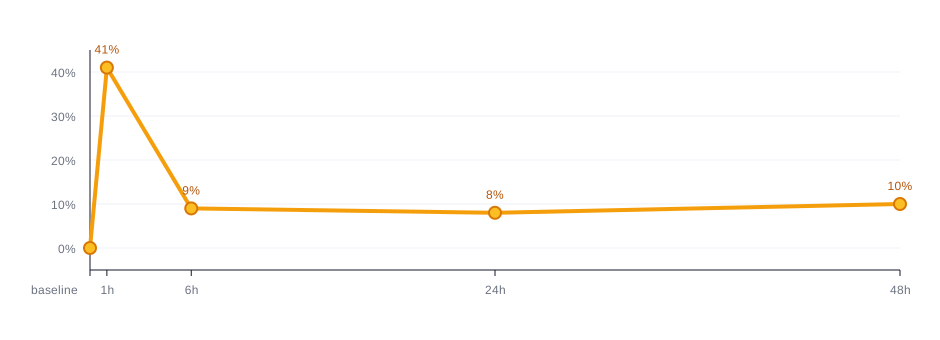 Time-course chart of PSA levels after ejaculation, showing a sharp early rise followed by a return toward baseline over the next several hours and days.Download
This shows a short-lived PSA rise after ejaculation. In simple terms: ejaculation can change the test result for a day or two, so it matters for screening timing, but it is not evidence that ejaculation prevents cancer.
The American Urological Association does not tell men to masturbate twenty-one times per month to prevent prostate cancer. The European Association of Urology does not do this. The NCCN does not build prevention strategy around it.
These are not minor omissions. These organizations publish extensive, rigorously updated frameworks on prostate cancer risk, detection, stratification, and management. They have plenty to say about family history, age, ancestry, genetics, screening, pathology, and treatment. They do not quietly forget to mention a major preventive behavior. They omit it because the evidence does not justify turning it into guidance.
Why not? Because people who work close to the evidence understand the gap between:
- an observational correlation
- and a clinically actionable recommendation
They also understand the cost of pretending the gap does not exist. A man with real risk factors can hear this slogan and come away with a false sense of security. Family history, ancestry, metabolic condition, smoking, obesity, symptom patterns, screening decisions, and actual urological follow-up matter far more than internetized masturbation quotas.
If a weak association gets marketed as protection, people can start acting as if they have already reduced their risk when they have not. The PSA papers help show the difference. Ejaculation can temporarily raise PSA enough to affect how the blood test is read, which is why some doctors may want abstinence before testing. That is just a testing precaution. It is not evidence that ejaculation prevents prostate cancer [5][6].
Why This Claim Became So Popular
The deeper reason this myth spread has almost nothing to do with oncology.
- It spread because it performs several social functions at once.
- It medicalizes indulgence.
- It turns pleasure into permission.
- It turns an urge into a health practice.
- It gives journalists an irresistible headline.
- It gives campaigns a provocative hook.
- It gives lonely men a scientific excuse.
- It gives the culture one more way to frame restraint as irrational.
That is why the number keeps showing up with such absurd confidence. It does not survive because the evidence is overwhelming. It survives because it is psychologically convenient. The public loves a conclusion that blesses appetite while wearing a lab coat.
What Actually Moves Risk
If you want the concrete factors that matter most, the list is much less exciting than the slogan. Age is the biggest one. After that come inherited risk, family history, ancestry, and germline predisposition. Those are the factors most consistently tied to who gets prostate cancer in the first place [7].
That is also why the modifiable side of the story is more limited than people want. The literature does not give you a clean behavioral rule that reliably prevents prostate cancer the way a vaccine or a drug can prevent a disease. The 2017 aggressive-cancer paper says strong modifiable risk factors are still lacking, and the 2024 narrative review lands in basically the same place [3][7].
What is actionable is mostly this:
- Know your baseline risk.
- Take family history and inherited predisposition seriously.
- Do not ignore urinary symptoms or screening decisions with your clinician.
- Keep body weight, smoking, diet, and activity in a healthier range because they matter for general health and may matter more for aggressive or poorer-outcome disease than internet folklore does.
That is less glamorous, but it is much closer to the evidence [7].
It is also why screening and detection behavior matter so much in this literature. PSA testing and biopsy behavior change what gets found and when, which is why the Harvard cohort had to adjust for screening history and still could not fully rule out residual confounding [2].
The same pattern shows up in the variable lists the papers spend time controlling for. The 2016 update adjusted for race, family history, BMI, physical activity, diet, smoking, vasectomy, and PSA testing. The 2017 aggressive-cancer paper adjusted for age, family history, BMI, smoking, alcohol, STI history, ethnicity, and PSA testing [2][3].
That is a clue about what the studies themselves think is capable of distorting the estimate. Ejaculation frequency is the headline. The real background structure is age, inherited risk, screening behavior, and broader health status.
If the medical excuse falls away, what still feels worth defending?
The Real Conclusion
The "21 times a month" recommendation is not a serious medical law. It is a corrupted translation of weak-to-moderate epidemiological data into a culturally useful slogan. Even the friendlier reading of the evidence only stretches to a possible relationship with lower-risk disease, and the more aggressive-disease analyses do not turn that into a universal prevention rule [2][3][4][7].
The number itself is arbitrary. The causal claim is unproven. The signal is entangled with bias and confounding. The supposed benefit does not convincingly extend to the forms of prostate cancer that actually threaten life. And no serious guideline body treats the behavior as a real preventive standard.
So say it cleanly: ejaculating twenty-one times per month is not a shield against prostate cancer. It is not a medical quota. It is not a substitute for real screening, real risk assessment, or real clinical judgment. It is an epidemiological artifact that got turned into propaganda because the culture wanted the conclusion more than it wanted the truth.
Key Terms
HR and OR: HR means hazard ratio. OR means odds ratio. These are two ways researchers compare one group to another. 1.0 means no difference. Below 1.0 means the exposed group had fewer cases. Above 1.0 means it had more. They show relative difference, not the raw chance of getting the disease.
IRD: incidence rate difference. This is the actual difference in how many new cases showed up between groups over time. Unlike HR or OR, it is closer to plain language because it tells you the size of the gap, not just the ratio.
Person-years: one person followed for one year, or the equivalent amount of follow-up across many people.
Low-risk prostate cancer: cancers that are usually small, localized, and less likely to threaten life.
Lethal prostate cancer: cancers that lead to prostate-cancer death or spread to bone or other organs.
PSA: prostate-specific antigen, a screening marker in the blood that can change for reasons other than cancer.
Screened cohort: in the Harvard follow-up analysis, the subgroup of men who had already undergone PSA screening, used to check whether the finding might just be a byproduct of who got tested.